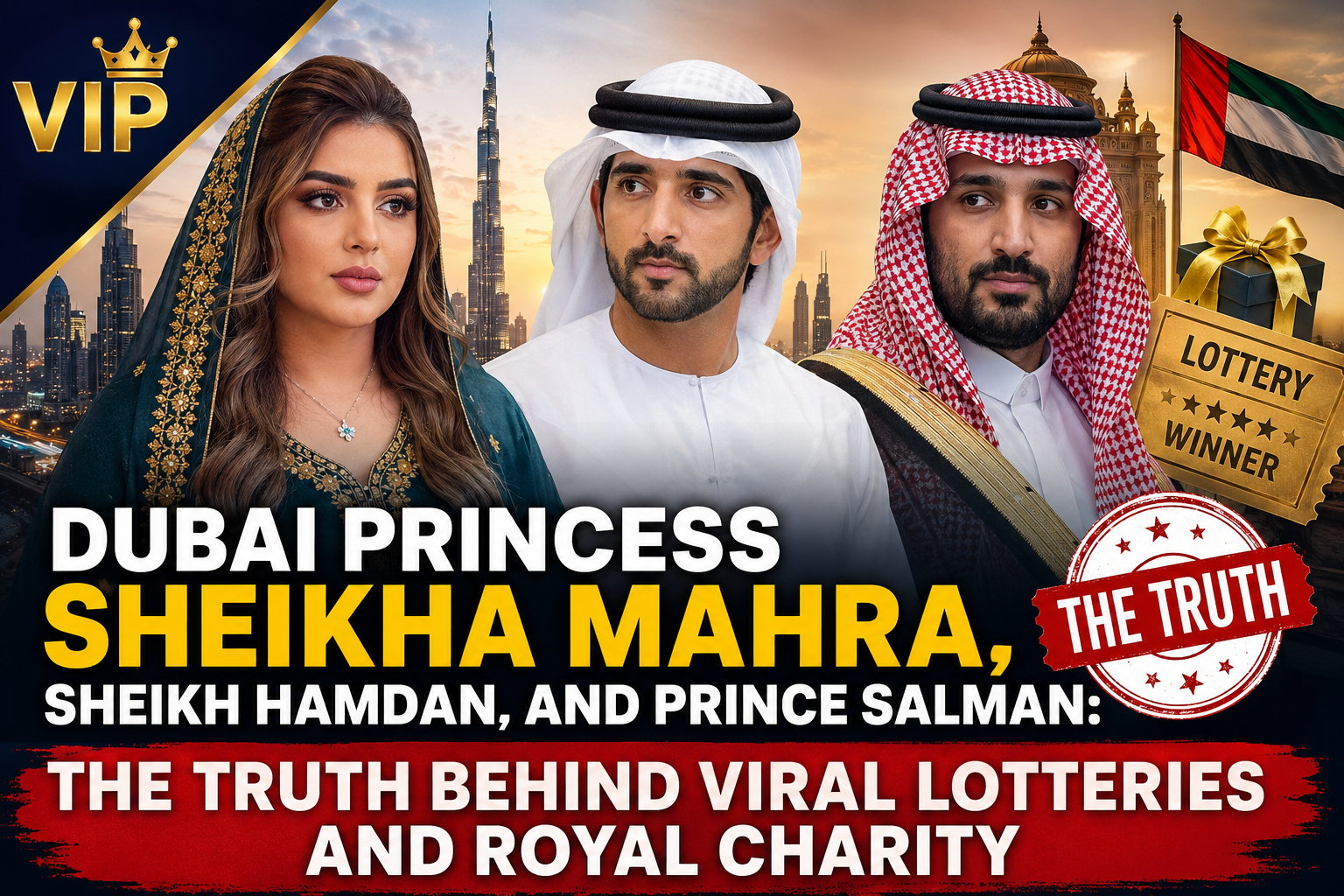
Social media has made it easy for information to travel across borders within minutes. Unfortunately, this also makes it easier for scammers to use the names, photographs, and reputations of famous people to create convincing false offers.
One recurring example involves viral posts and private messages claiming to be connected with Dubai Princess Sheikha Mahra, Sheikh Hamdan, or a royal figure referred to as Prince Salman. These messages may promise large lottery prizes, financial assistance, charity payments, gifts, or special opportunities.
The important question is simple: Are these offers genuine?
There is a major difference between legitimate charitable initiatives associated with public figures and an unsolicited WhatsApp, Facebook, Instagram, Telegram, or email message claiming that an individual has personally won money. Reports and online discussions have documented scams using Sheikh Hamdan’s name, including claims that recipients had won substantial sums and needed to pay money before receiving the supposed prize.
Therefore, readers should treat unexpected “royal lottery” messages with caution and verify claims through reliable official channels.
Who Is Sheikha Mahra?
Sheikha Mahra bint Mohammed bin Rashid Al Maktoum is a member of Dubai’s ruling family and the daughter of Sheikh Mohammed bin Rashid Al Maktoum. She became particularly well known internationally through her public social-media presence and her widely reported personal announcements.
Her public profile makes her name attractive to impersonators. A scammer does not necessarily need to create a completely fake story. Instead, the fraudster may copy photographs, names, logos, videos, or other publicly available material and combine them with a false lottery or charity claim.
This is one reason people should never assume that a social-media post is authentic simply because it contains photographs of a well-known royal.
What About Sheikh Hamdan?
Sheikh Hamdan bin Mohammed Al Maktoum is a prominent member of Dubai’s ruling family and has served as Crown Prince of Dubai. His public profile and popularity make his name particularly attractive to people attempting to gain trust online.
A documented online example describes a victim receiving a message claiming to be from a “Sheikh Hamdan Foundation Lottery.” The individual was allegedly told that he had won millions of dollars but first needed to make a payment in cryptocurrency. This is a classic warning sign associated with advance-fee fraud.
Importantly, an online message using a royal name is not evidence that the royal or a legitimate foundation is behind it.
What Is the “Royal Lottery” Story?
The typical viral story follows a familiar pattern.
A person receives a message saying:
- You have been selected as a winner.
- A Dubai royal or royal foundation is sponsoring the prize.
- You have won a large amount of money.
- Your prize is waiting to be transferred.
- You need to pay a registration, processing, delivery, tax, or verification fee.
- You may need to provide personal or financial information.
The amounts can vary considerably. Some fake messages promise thousands of dollars, while others claim prizes worth hundreds of thousands or even millions.
The problem is not the size of the prize. The biggest warning sign is the request for money before the supposed prize can be released.
Lottery scams are a recognized form of advance-fee fraud. The victim is told that a prize exists and is then asked to pay a fee or provide information before receiving it.
Is Sheikha Mahra Personally Offering a Lottery?
There is no reliable basis for treating random viral posts or private messages using Sheikha Mahra’s name as proof of an official lottery.
Several online pages currently use phrases such as “Sheikha Mahra Lottery” and advertise large prize amounts. The existence of such pages, however, does not establish that they are operated by Sheikha Mahra or an authorized organization.
This distinction is extremely important.
A website, Facebook page, WhatsApp account, or social-media profile can use a person’s name without that person’s authorization.
Before believing a prize announcement, readers should look for confirmation from a verified official source rather than relying on screenshots, forwarded messages, or videos.
What About Prince Salman?
The phrase “Prince Salman” can refer to different members of royal families, depending on the country and context. Viral posts sometimes use a royal title or first name without providing enough information to establish the identity of the person involved.
This creates another warning sign.
If a message claims that “Prince Salman” is offering money, a lottery, employment, charity assistance, or a personal gift, users should ask:
- Which Prince Salman?
- What is the official organization?
- Is the announcement published on an authenticated official channel?
- Is there an independently verifiable charity or program?
- Why is the recipient being contacted privately?
- Why is an advance payment required?
Without credible answers to these questions, the offer should not be treated as genuine.
How Royal Impersonation Scams Work
Royal impersonation scams depend heavily on trust and authority.
A scammer may use:
- Royal photographs
- AI-generated or edited videos
- Fake certificates
- Fake lottery numbers
- Imitation social-media profiles
- WhatsApp phone numbers
- Fake charity websites
- Official-looking logos
- Fake documents
- Testimonials from supposed winners
Recent reporting has also highlighted the broader problem of scammers using manipulated or deepfake material while impersonating Dubai royalty. One reported case involved a scammer posing as a Dubai prince and persuading a victim to make payments for supposed documents and a royal membership card.
This demonstrates why seeing a convincing photograph or video is no longer enough to establish authenticity.
Genuine Charity vs. Fake Charity
Dubai and the UAE have legitimate philanthropic organizations and initiatives. For example, the Mohammed Bin Rashid Al Maktoum Global Initiatives (MBRGI) is a real philanthropic umbrella initiative associated with Sheikh Mohammed bin Rashid Al Maktoum and has operated charitable and humanitarian programs.
That does not mean every charity message using a Dubai royal’s name is genuine.
A legitimate charitable organization normally has identifiable information such as:
- An official website
- Verifiable organizational details
- Public contact information
- Clearly described programs
- Transparent donation procedures
- Official social-media accounts
A random message asking for cryptocurrency, gift cards, bank transfers, or “release fees” should be considered suspicious.
Five Warning Signs of a Fake Royal Lottery
1. You Never Entered a Lottery
If you never purchased a ticket or entered an official competition, an unexpected winning notification should immediately raise questions.
2. You Must Pay First
Requests for “processing fees,” “release charges,” “registration fees,” or similar payments are among the strongest warning signs.
3. The Contact Is Private
A supposed national or international charity program relying exclusively on an unknown WhatsApp number is difficult to verify.
4. The Message Creates Urgency
Scammers may tell recipients that they have only a few hours to claim their money.
Urgency discourages people from independently checking the claim.
5. Personal Information Is Requested
Be cautious if a stranger asks for your bank details, identification information, passwords, one-time codes, cryptocurrency wallet information, or other sensitive data.
What Should You Do If You Receive a Message?
Do not send money immediately.
Instead, save the message and independently investigate the organization mentioned in it. Search for the organization using reliable sources rather than clicking suspicious links contained in the message.
Do not provide passwords, verification codes, banking credentials, or unnecessary personal information.
If you have already transferred money, contact your bank or payment provider as soon as possible and report the incident to the relevant authorities or platform.
The Bottom Line
The popularity of Sheikha Mahra, Sheikh Hamdan, and other members of Gulf royal families has created opportunities for online impersonators.
The central lesson is simple: a royal name does not make a lottery offer legitimate.
Viral claims about huge prizes, surprise donations, or personal financial gifts should be independently verified before anyone sends money or personal information. Reports of scams using Sheikh Hamdan’s name demonstrate how convincing these schemes can appear.
Likewise, the existence of genuine charitable initiatives in the UAE should not be confused with unsolicited messages promising individual cash prizes.
When in doubt, stop, verify the source, and never pay an unexpected fee simply because a message claims to come from royalty.
Frequently Asked Questions
Is the Sheikha Mahra lottery real?
Unverified social-media pages and messages should not be treated as proof of an official Sheikha Mahra lottery. Verify any claim through an authenticated official source before taking action.
Is Sheikh Hamdan giving money to people through WhatsApp?
Messages claiming to offer money in Sheikh Hamdan’s name can be impersonation scams. Reports have documented fraudulent lottery messages using his name.
Do real lotteries ask winners to pay cryptocurrency first?
An unexpected demand for cryptocurrency or another advance payment is a major scam warning sign. Do not send money merely to “unlock” a supposed prize.
Can a royal charity contact people online?
Legitimate organizations can use digital communication, but a message should still be independently verified. A royal name, photograph, or logo alone does not establish authenticity.
What should I do with a suspicious lottery message?
Do not respond with sensitive information or payment. Preserve the evidence, independently verify the organization, and report suspicious activity through the relevant platform and authorities.
Final Takeaway
The internet has made it easier than ever to communicate with organizations and public figures, but it has also made impersonation easier. Viral Dubai royal lottery stories should therefore be approached with skepticism.
Whether a message mentions Sheikha Mahra, Sheikh Hamdan, Prince Salman, or another prominent royal figure, the same rule applies: verify first, pay nothing upfront, and never assume a viral post is official.